The MYRAZONIT technology: three steps to fertile soil and a big harvest
Our technology is a system you can follow. It helps cut costs, save fuel and make the soil work for you. We answer specific problems of the field in three stages.
STEP 1. IMPROVING THE SOIL AND WORKING THE STUBBLE
Problem: crop residue rots slowly, gets in the way of sowing and becomes a home for pests.
The soil is depleted and turns compacted.
Solution: turn crop residue into free nutrition for the next harvest.
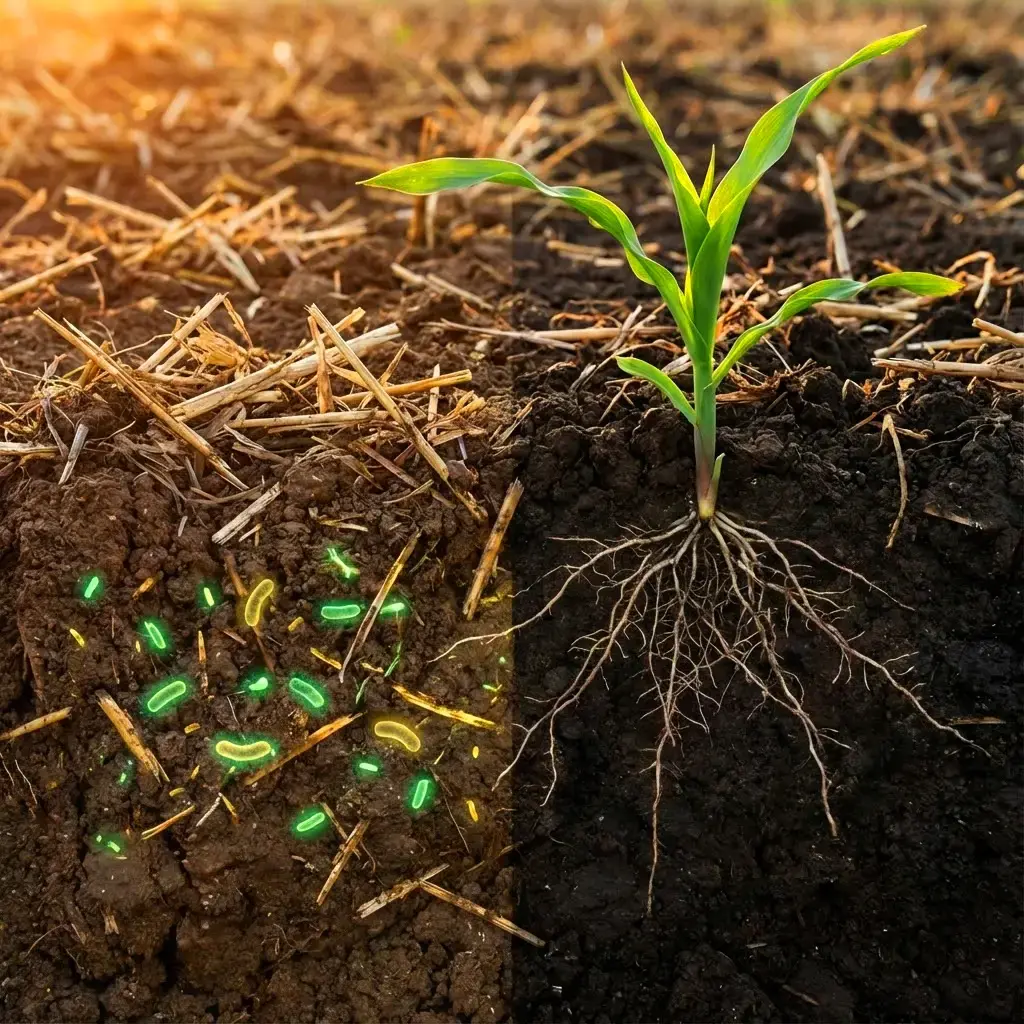
The bacteria in our product work as a stomach for the soil.
They break down straw and root residue quickly, turning them into available minerals.
What the farm gets:
- Fertiliser savings: stubble is a store of nutrients.
The bacteria open that store, and the next crop is fed for free.
- Easier cultivation: the soil turns loose and crumbly.
The tractor pulls more easily, and you spend less fuel and less time.
- Disease protection: stubble that rots fast leaves pests and fungi nowhere to overwinter.
No home, no pest.
- Moisture: loose soil takes in rainfall better and holds moisture through a drought.
How to apply:- Where: onto the residue of any crop after harvest.
- How much: 10–20 litres per hectare.
- How: chop the stubble, spray it and immediately mix it into the topsoil.
- Ideally all in one pass.
RECOMMENDED PRODUCT FOR THIS STAGE:
MYRAZONIT STUBBLE DECOMPOSER
A specialised formulation that turns crop residue into humus.
STEP 2. TREATING THE ROOT ZONE (INOCULATION)
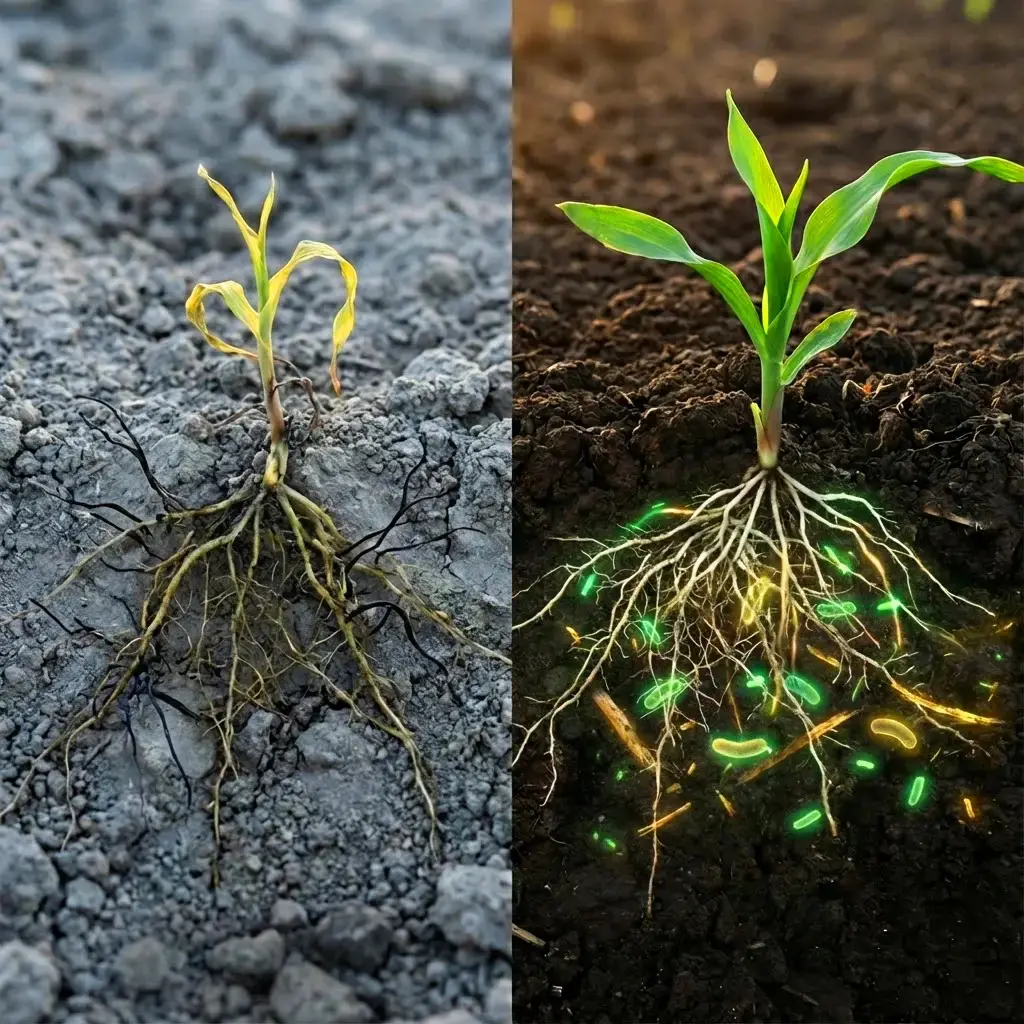
Problem: weak emergence, plants short of strength at the start, roots that develop badly.
Solution: settle the root zone with useful bacteria at sowing.
We return the soil's native bacteria, the ones that help the plant feed. The job of this stage is to give the plant nitrogen and phosphorus in a form it can take up.
Why nitrogen and phosphorus matter here
- Nitrogen (N): the building material for growth.
It is responsible for green mass.
- Result: the plant grows upward quickly, the stem thickens and the leaves turn deep green.
Phosphorus (P): energy, and the strength of the roots.
Result: a powerful root system forms. The bigger the root, the better the plant drinks and the better it takes drought. Phosphorus gives the seed the energy to germinate.
How it works:
- Azotobacter: this bacterium captures nitrogen straight from the air and passes it to the roots.
That is your natural fertiliser.
- Phosphorus mobilisers: soil often holds plenty of phosphorus, but it is locked up and the roots cannot take it.
These bacteria dissolve that phosphorus and feed it to the plant.
How to apply:
- For any crop: 10–20 litres per hectare.
- Application: at sowing. Either in-furrow for row crops, or mixed into the soil for cereals.
RECOMMENDED PRODUCT FOR THIS STAGE:
MYRAZONIT SOIL INOCULANT
A living starter for the soil that gets the root system going.
STEP 3. REGENERATION AND PROTECTION AGAINST DISEASE
Problem: root rots and fungal diseases such as fusarium, which kill the crop while it is still starting or leave it weakened.
Solution: biological protection for the root, without extra chemistry.
At this stage we build a living shield around the root. A healthy root takes up the same nitrogen and phosphorus discussed above far better.
How it works, in plain words:
The useful bacteria release particular substances — siderophores.
(from the Greek sideros, iron, and phoros, carrying)
- What are they? Traps for iron.
- How does that protect the crop? Pathogenic fungi need iron to reproduce. Siderophores take all the iron for themselves and hand it to the plant. The harmful fungi are left with nothing to eat, stop developing and die.
What the farm gets:
- Lower spending on treating the crop.
- Even, healthy emergence with no gaps.
- A cleaner harvest.
How to apply:- Rate: 10–20 litres per hectare.
- Application: into the soil at sowing, the same as the previous step.
RECOMMENDED PRODUCT FOR THIS STAGE:
MYRAZONIT SOIL REGENERATOR
A biological shield that drives disease out of the root zone.