
MYRAZONIT Stubble Decomposer
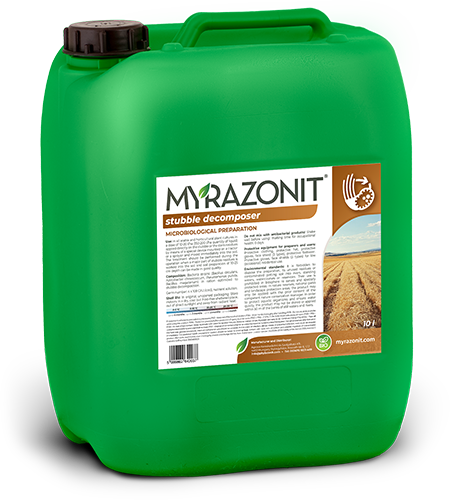
Turning straw into free nutrition and making the tractor's work easier.
Stubble and crop residue are money lying on your field.
Instead of letting them get in the way of sowing and rot for years, put them to work.
Our product acts as a powerful stomach for the soil: it breaks down tough stems fast, turning them into humus and available fertiliser for the next crop.
What that gives you in practice.
Free fertiliser. The bacteria return the nitrogen, phosphorus and potassium left in the straw to the soil. You spend less on mineral fertiliser.
Price: 370 ₽ 230 ₽ / 1 litre*
* Promotional price until 31 October 2026
Fuel savings. Treated soil turns loose. The tractor pulls a plough or a disc harrow more easily, and diesel consumption drops noticeably — by 20–30%.
A clean field. Pests and diseases overwinter in stubble. The bacteria destroy their home by breaking the residue down fast.
No stubble, no disease.
Composition
One canister holds a team of bacteria at high concentration — 400 million per cubic centimetre.
Each strain has its own job:
- Bacillus circulans and Bacillus megaterium: the main straw destroyers.
- Azotobacter chroococcum: captures nitrogen straight from the air and stores it in the soil.
- Pseudomonas putida: protects the soil from disease and stimulates the growth of the coming crop.
How to apply
The product is simple to use, but the proportions and the technique have to be respected. It suits any crop.
Application rates
- Product rate: 10–20 litres per hectare. (Plenty of straw on the field — go closer to 20 l; not much — 10 l is enough.)
- Spray volume: 150–200 litres of prepared solution per hectare.
How to mix (proportions)
Mix straight in the sprayer tank, with clean water.
For 200 litres of solution per hectare, combine:
- Water: 180–190 litres.
- MYRAZONIT: 10–20 litres.
Application technique (the one-pass rule)
Bacteria are living organisms and direct sun kills them.
They have to go into the ground.
Step 1: Chop the stubble. The finer it is, the faster the bacteria eat it.
Step 2: Spray the residue with the prepared solution.
Step 3: Immediately — no delay — work the product into the soil to a depth of 10–25 cm.
One important tip: the best method is to mount the nozzles straight onto the disc harrow or the plough.
That way you apply and incorporate the product in a single pass. What matters most is mixing the straw into the soil thoroughly.
Seasonal offer
The whole MYRAZONIT range — at one price
Stubble decomposer, soil inoculant, soil restorer.
You save 140 ₽ on every litre — 140 000 ₽ on every tonne.