
MYRAZONIT Soil Inoculant
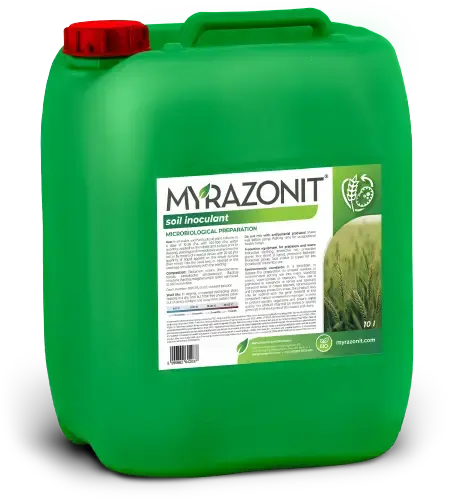
A living starter for a powerful root system.
Fertiliser eats the largest share of a farm's budget. But what is the point, if the plant has weak roots and cannot take up what you gave it? Our inoculant solves that: it settles the soil with useful bacteria that work like a pump, drawing nutrition and water to the roots and saving the plant's own energy.
What is an inoculant? (from the Latin inoculatio, «grafting»)
A prepared medium with a high concentration of useful bacteria.
Inoculation is the process of settling those bacteria into the zone where the seed will grow.
Price: 370 ₽ 230 ₽ / 1 litre*
* Promotional price until 31 October 2026
In nature these bacteria should live in the soil by themselves, but ploughing and chemistry have left almost none of them there.
We simply put them back, grafting life into the soil so it works for your harvest.
How it works in practice
The bacteria from the product settle directly on the plant's roots and live with it in symbiosis all season.
A powerful root means drought protection.
The bacteria stimulate root hair growth. There are more roots and they go deeper. In a drought a plant like that reaches moisture down below while others dry out.
The plant saves its strength.
Normally a plant spends enormous energy searching for nutrition. Here the bacteria bring the food — nitrogen and phosphorus — to its door. The energy that frees up goes into stem growth and yield.
Mineral fertiliser works harder.
If you apply mineral fertiliser, the bacteria help the plant take up all of it instead of leaving it in the ground as dead weight.
Composition.
This is the heavy artillery among biological products. The concentration of bacteria is higher still than in the stubble product — 1 billion per cubic centimetre.
The bacteria team:
- Azotobacter chroococcum: the main nitrogen supplier.
- Bacillus circulans and Bacillus megaterium: mobilise phosphorus and potassium.
- Pseudomonas putida: protects the root from disease.
- Bacillus subtilis: strengthens the plant's immunity (hay bacillus).
How to apply
The product is universal: cereals, row crops such as sunflower and maize, and vegetables.
There are two ways to apply it. Choose the one that fits your machinery.
Overall product rate:
10–20 litres per hectare.
Method 1.
Broadcast application (sprayer + cultivation)
Use this when your drill has no dedicated equipment. You treat the whole field before sowing.
1. Preparing the mix (per hectare)
You need 100–300 litres of working solution per hectare (the water volume depends on your sprayer — what matters is covering the soil evenly).
- Water: 90–280 litres.
- Product: 10–20 litres.
Technique
- Pour the mix into the sprayer.
- Treat the soil before sowing.
- Important: incorporate the product into the soil straight away, with a cultivator or a harrow, so the bacteria do not die in the sun.
Method 2.
In-furrow application.
The most economical and effective method. The product goes down with the drill, straight into the furrow beside the seed.
Preparing the mix (per hectare)
Less water here, because the application is targeted.
Total solution volume — 20–50 litres per hectare.
- Water: 10–30 litres.
- Product: 10–20 litres.
Technique
- Fit the drill with a liquid fertiliser system (or the MYRAZONIT kit).
- Set the nozzles so the liquid lands directly in the seed bed.
- Sow as usual. The bacteria reach the seed at once and are covered by soil.
The one rule: do not mix the product with chlorinated water or with aggressive chemistry that can kill the bacteria. If you are unsure, ask us.
Seasonal offer
The whole MYRAZONIT range — at one price
Stubble decomposer, soil inoculant, soil restorer.
You save 140 ₽ on every litre — 140 000 ₽ on every tonne.